
The commercial stretcher flight is WIA’s primary differentiator. A commercial stretcher flight on a scheduled Air France service carries patients who must lie flat for the full journey, including severe cases, intubated patients and those on a ventilator. The deciding factor is not clinical severity. It is the destination: as long as the final airport is served by Air France or an equivalent commercial airline that offers onboard stretchers, a stretcher on a scheduled flight is the first option WIA evaluates.
This is the solution that sets WIA apart. Most operators default to an air ambulance for anything beyond a stable, seated patient. WIA’s 15 years of experience with commercial airline stretcher transport means they know what is possible on a scheduled service, and they use it.
This is the clinically appropriate choice for patients who can remain seated for the full flight and whose destination is served by a commercial airline. It is not a budget fallback. It is the right solution when it fits.
What Is a Commercial Airline Stretcher Flight? The Service Explained
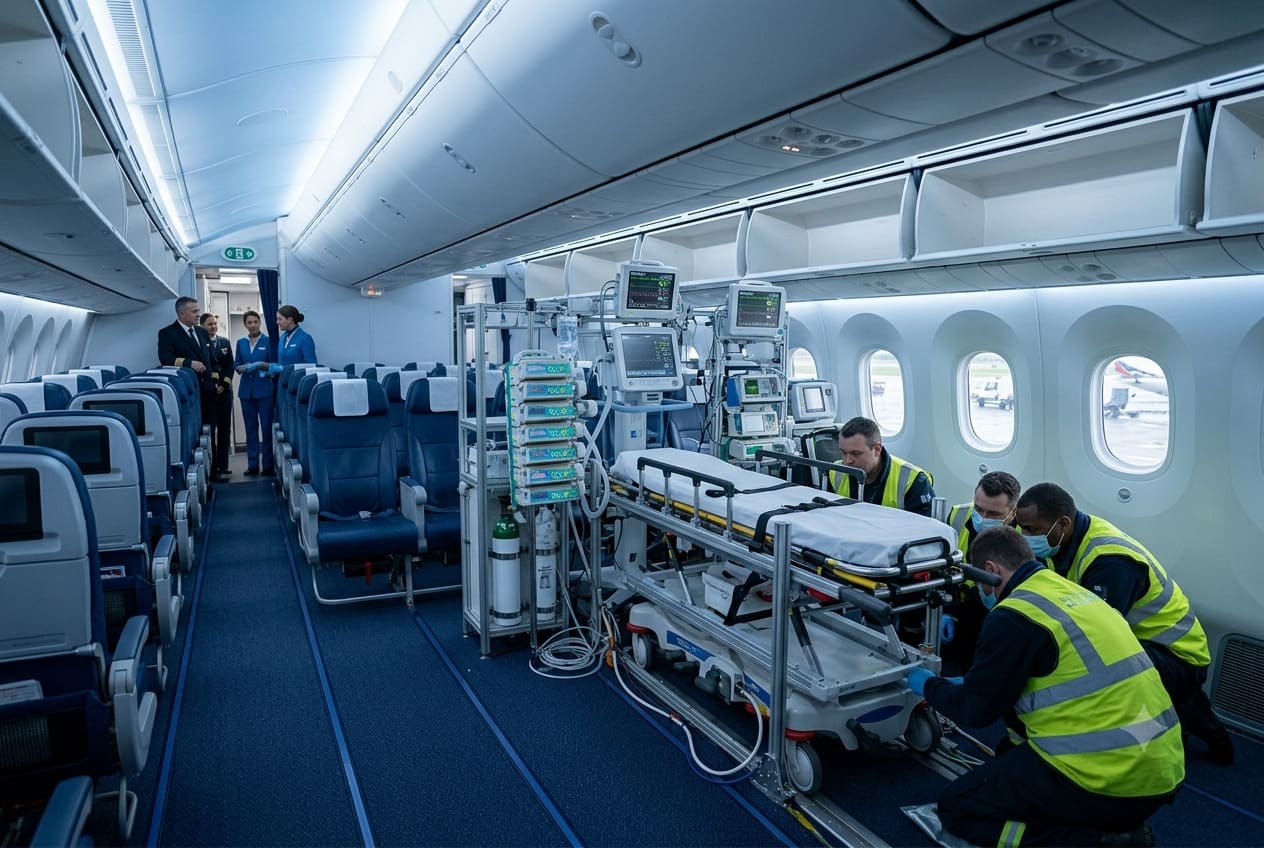
A commercial airline stretcher service works as follows. Several rows of seats are removed from a scheduled commercial aircraft before the flight. An air stretcher unit is installed in that space. The patient lies flat in the cabin for the full duration of the flight, attended by a nurse or doctor from WIA’s medical team. Other passengers travel in the rest of the cabin. The aircraft is a standard commercial airplane on a regular scheduled route.
The stretcher option on a commercial aircraft is not a makeshift arrangement. Airlines that operate stretcher services, including Air France, have established procedures for stretcher installation, medical clearance and boarding. The patient’s medical transport process follows the same structured approach as any other repatriation WIA coordinates: medical assessment, medical transport needs airline coordination, escort briefing and ground ambulance transfers at both ends.

Commercial Stretcher Flights and Patient Severity: Correcting a Common Misconception
The most important thing to know about this service is what it is not. A commercial stretcher flight is not reserved for mild cases or stable patients with minor medical needs. It handles bedridden patients, patients with serious medical conditions, injuries or fractures that prevent them from being seated, and patients who require a ventilator or continuous oxygen throughout the flight. WIA has repatriated intubated, ventilated patients on scheduled Air France services.
What determines whether a stretcher flight is possible is not how sick the patient is. It is whether the destination is served by a commercial airline from Martinique or Guadeloupe. If Air France flies there, the stretcher option is clinically sound.
Commercial Stretcher Service vs. Air Ambulance Services: The Real Difference
An air ambulance is needed when the destination airport is too small for commercial airlines, or when a wing-to-wing transfer requires a dedicated aircraft for the second leg. In all other cases, the commercial airline stretcher is evaluated first. On the same route, a stretcher flight typically costs 60 to 70% less than air ambulance services. However, that can vary depending on the route.
Stretcher Flight vs. Commercial Medical Flight: Which Patients Need Which?
The difference is posture. A commercial medical flight carries patients who are fit to fly and can sit upright in business class for the full journey. A commercial stretcher flight carries patients who cannot sit upright at all: hip fractures, post-surgical conditions requiring lying flat, or patients whose medical conditions make any seated travel impossible. Both solutions include a medical escort and work for destinations served by major airports. The stretcher option costs more than a seated commercial flight but significantly less than a dedicated aircraft.
→ Transport decision process: how WIA chooses the right solution
→ Medical assessment: fitness to fly and stretcher eligibility
Commercial Stretcher Flight, Commercial Medical Flight and Air Ambulance Aircraft: Side by Side
A direct comparison of the three main patient transport options from the Caribbean.
| Commercial Stretcher Flight | Commercial Medical Flight | Air Ambulance | |
|---|---|---|---|
| Patient posture | Must remain lying flat for the full flight | Can sit upright in business class | Any — typically critical or unstable |
| Destination | Major international airport served by commercial airline | Major international airport served by commercial airline | Any airport, including small regional airports |
| Medical level | Nurse or/and doctor on board throughout | Nurse or/and doctor on board throughout | Intensive care unit equipment and crew |
| Relative cost | Optimised | Lower | Highest |
| Clinical severity | All levels including intubated and ventilated patients | Stable patients fit to fly seated | All levels — triggered by route, not severity |
| Who decides | WIA medical team after assessment with attending physician | WIA medical team after assessment with attending physician | WIA medical team after assessment with attending physician |
→ Full transport options guide
How WIA Organises a Commercial Stretcher Flight: Step by Step
From the first call to the patient’s arrival at home or at hospitals at destination, WIA manages every element of the journey. The stretcher flight coordination involves one additional step compared to a standard commercial medical escort flight: the stretcher installation, which requires direct coordination with the airline’s technical team before departure.
| Step | Stage | What Happens |
|---|---|---|
| 1 | Case opening | WIA receives the case from the insurance company or directly from the patient or family. A medical coordinator is assigned immediately. |
| 2 | Medical assessment | WIA’s medical team reviews the patient’s clinical file with the attending physician at the CHU de Martinique, CHU de Guadeloupe or any hospital in the Caribbean. Posture requirements, medical conditions, oxygen needs and escort level are confirmed. Medical clearance is requested from the airline. |
| 3 | Stretcher installation coordination | WIA coordinates the stretcher installation with Air France or the relevant commercial airline. Several rows of seats are removed from the aircraft and the air stretcher unit is fitted by the airline’s technical team before the flight. |
| 4 | Medical team briefing | The nurse or/and doctor assigned to the flight is briefed on the patient’s clinical file, medication plan, ventilator settings if applicable, and any specific medical interventions required during the flight. |
| 5 | Departure | A road ambulance transfers the patient from the hospital to the airport. The patient boards via a separate access route. The medical escort travels with the patient for the full flight duration. |
| 6 | Arrival and handover | At destination, an ambulance meets the flight and transfers the patient to their home or receiving hospital. The escort hands over directly to the receiving medical professionals or family with a full clinical summary. |
→ Full bed-to-bed coordination process
Commercial Flights with Stretcher Service from Martinique and Guadeloupe: Routes and Travel
Commercial Stretcher Service on Air France: Caribbean to Europe Flights
Air France operates air stretcher configurations on international flights from Aimé Césaire International Airport in Martinique and Pôle Caraïbes in Guadeloupe to Paris Charles de Gaulle and Paris Orly. These are long-haul international flights of approximately eight hours, suitable for stretcher transport with the right medical support on board. From Paris, the patient can continue to their final destination by road ambulance or, for longer distances, a second commercial or dedicated flight.
For patients returning to the United Kingdom, Germany, Belgium, the Netherlands or elsewhere in Europe, the Paris connection is the standard routing. WIA coordinates the full journey including the onward leg from Paris to the patient’s home or receiving medical facility.
→ Medical repatriation to Europe: routes and coordination
Stretcher Transport for Patients Travelling to Canada, the US and the Americas
For patients returning home to Canada or the United States, WIA assesses available commercial airline options case by case. Routes, connection times and stretcher slot availability are reviewed with each airline. For South American destinations, the same assessment applies. WIA’s coordination team is experienced with the full range of patient transport options from the Caribbean and identifies the most appropriate solution for each travel itinerary.
→ Medical repatriation to the Americas: routes and coordination
→ Request a stretcher flight quote — 24/7
→ Insurance companies: B2B coordination and case submission
Medical Care on Board: The Medical Escort and Medical Equipment
Every WIA commercial stretcher flight includes a qualified medical escort: a nurse or/and doctor, not airline staff. The escort is briefed on the patient’s full clinical file before departure, including diagnosis, current treatment, medication schedule and any specific medical needs for the journey. They travel with the patient from hospital departure to final destination.
Medical Staff and Equipment for Stretcher Patients
For patients with higher medical needs, the medical team carries medical equipment appropriate to the patient’s condition: oxygen supplied by the airline, medication, monitoring equipment and, where required, ICU equipment. The medical team determines what is needed during the assessment phase, in direct contact with the attending physician at the CHU de Martinique or CHU de Guadeloupe.
Air France provides medical-grade oxygen on board its international flights, which supports patients with elevated oxygen requirements during the journey.
Commercial Stretcher Flight Service for Insurance Companies and Hospitals
The commercial airline stretcher is WIA’s most-used repatriation solution. For insurance companies, it combines appropriate patient care with costs well below those of a dedicated aircraft. WIA works directly with more than 150 insurance companies, including major French ones like Europ Assistance (now Radion), AXA Assistance, Allianz Global Assistance, Inter Mutuelles Assistance, Mutuaide, Fidelia and FILA, on pre-authorisation, cost documentation and real-time case updates.
Hospitals that refer patients to WIA, including the CHU de Martinique in Fort-de-France and the CHU de Guadeloupe in Pointe-à-Pitre, know that WIA will recommend a stretcher flight whenever the destination and clinical profile allow it. That is the default, not the exception. When an air ambulance is genuinely needed, WIA says so clearly and explains why.
Frequently Asked Questions: Commercial Stretcher Flight Service
Is a commercial stretcher flight only for stable or mild cases?
No. This is the most important thing to understand about this service. A commercial stretcher flight can carry severe patients, including those who are intubated ventilated, as long as their destination is served by a commercial airline from Martinique or Guadeloupe. The deciding factor is the destination airport, not the patient’s clinical severity. WIA has been organising these transfers for 15 years.
How is an air stretcher fitted on a commercial aircraft?
Several rows of passenger seats are removed from the commercial aircraft before the flight. The air stretcher unit is then installed in that space by the airline’s technical team. The patient lies flat in the cabin, separated from other passengers. A nurse and/or doctor from WIA’s medical team travels in the same section for the full journey
What is the difference between a commercial stretcher flight and an air ambulance?
A commercial stretcher flight uses a standard scheduled aircraft on a regular commercial airline route, with an air stretcher installed in the cabin. An air ambulance is a dedicated aircraft that can land at smaller airports not served by commercial airlines. The choice depends primarily on the destination: if the final airport is served by Air France or an equivalent carrier, the commercial stretcher is evaluated first. The cost is typically 60 to 70% lower than an air ambulance on the same route.
Which airlines operate stretcher flights from Martinique and Guadeloupe?
Air France is WIA’s primary commercial airline for stretcher flights from Aimé Césaire International Airport in Martinique and Pôle Caraïbes in Guadeloupe. Air France operates air stretcher configurations on intercontinental routes to Paris Charles de Gaulle. Other carriers are assessed case by case depending on the destination and route.
Who contacts WIA to arrange a commercial stretcher flight?
In most cases, the patient’s insurance company contacts WIA directly to open the case. WIA manages the medical assessment, airline coordination, and escort assignment. When a patient is not covered for the return journey, WIA accepts direct mandates from patients, families and hospitals with transparent pricing before any commitment.
How long does it take to organise a commercial stretcher flight?
A stretcher repatriation on a scheduled commercial airline is typically organised within 24 to 48 hours of the initial medical assessment, subject to flight availability and stretcher slot availability on the relevant route. WIA’s coordination team responds to new cases 24 hours a day.
Ready to Organise a Commercial Stretcher Flight from the Caribbean?
WIA’s team is available 24 hours a day. Whether you are an insurance company with a patient ready for discharge from the CHU de Martinique or CHU de Guadeloupe, or a family organising a return home, the assessment starts from the first call.
