
How Medical Repatriation Works: The WIA Process from First Call to Arrival
The medical repatriation process starts with a phone call and ends at the patient’s door. Everything in between, from the medical assessment and transport decision to the flight itself and the handover at destination, is managed by WIA. This page explains each stage of the repatriation process so that families, insurance companies and hospitals know exactly what to expect before, during and after the journey.
The most common scenario WIA handles is a patient who has been treated at the CHU de Martinique in Fort-de-France or the CHU de Guadeloupe in Pointe-à-Pitre and is ready to return home: to France, the United Kingdom, Canada, the United States or elsewhere. These are not emergency evacuations. They are planned, medically supervised returns — and they follow a structured process that has been refined over 15 years and more than 1,500 repatriations.
The Medical Repatriation Process: Five Steps from Hospital to Home
Every WIA repatriation follows the same five-stage process. The steps are always the same. What changes is the transport mode, the escort level and the route, all of which are determined by the patient’s clinical situation and the destination.
| Step | Stage | What Happens | Where to Read More |
|---|---|---|---|
| 1 | Medical Assessment | WIA’s medical team reviews the patient’s clinical file with the attending physician. Fitness to fly, posture requirements, oxygen needs and escort level are assessed. Medical records are reviewed and medical evaluation is completed. | Full detail: Medical Assessment page |
| 2 | Transport Decision | Based on the assessment, WIA identifies the right transport solution. The destination airport is the primary factor: commercial airline first, dedicated aircraft when the route requires it. Insurance coverage parameters are reviewed at this stage. | Full detail: Transport Decision Process page |
| 3 | Coordination and Booking | WIA books the flight, briefs the medical escort, and requests medical clearance from the airline. Ground ambulances are booked at both origin and destination. | Covered on this page |
| 4 | Medical Escort and Flight | The patient travels with a nurse or doctor throughout the journey. WIA’s coordination centre in Fort-de-France remains in contact throughout. Medical support is available from departure to arrival. | Full detail: Medical Escort page |
| 5 | Bed-to-Bed Handover | On arrival, a ground ambulance meets the flight. The medical escort hands over to the receiving medical team, family or home care provider. Full documentation is provided. | Full detail: Bed-to-Bed Coordination page |
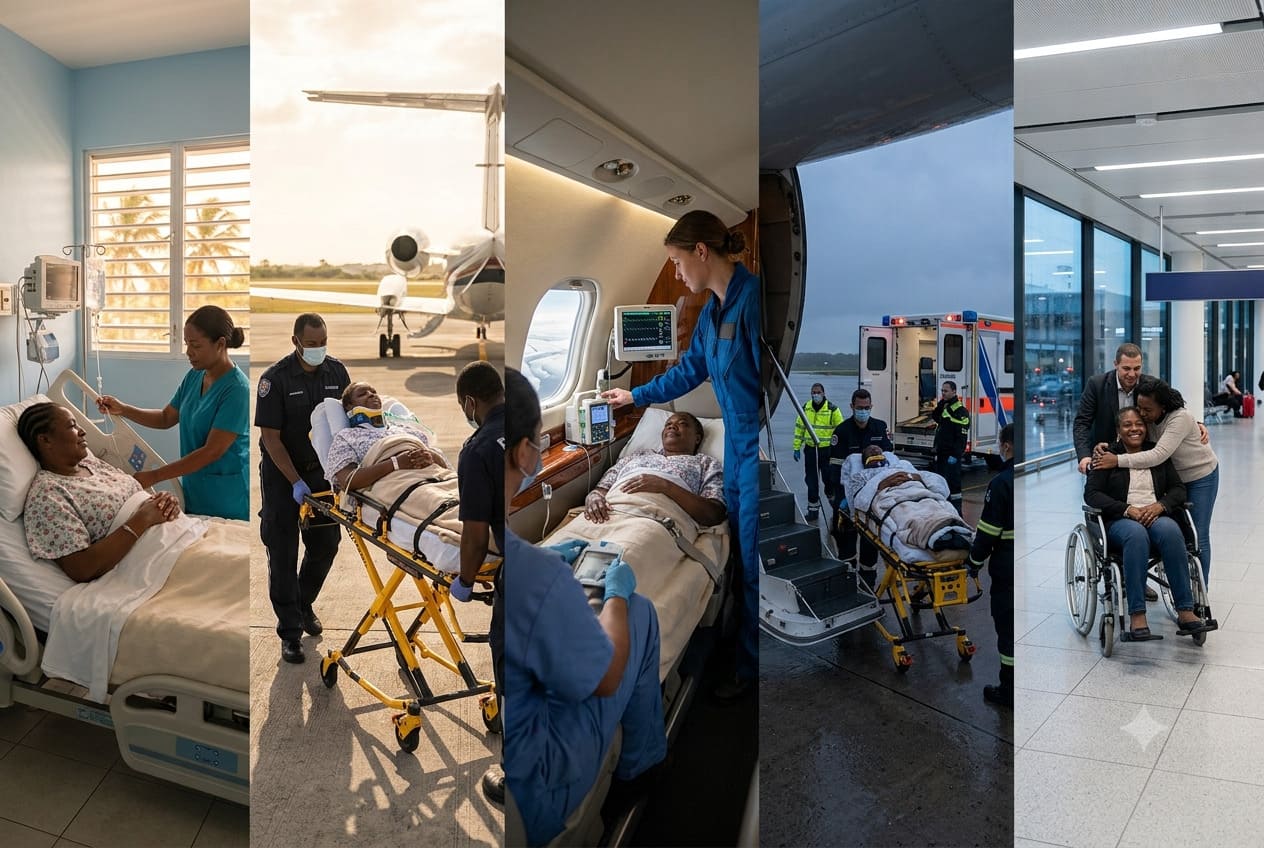
Step 1: Medical Assessment and Fitness to Fly Evaluation
Before anything is booked, WIA’s medical team speaks directly with the attending physician at the hospital. This is the medical assessment: a review of the patient’s clinical file, current treatment, medical records, medication and any specific requirements for the journey. It is not a formality. The outcome of this assessment determines everything that follows.
The medical evaluation covers fitness to fly, posture requirements (can the patient sit or must they lie flat?), oxygen and ventilator needs, escort level (nurse or doctor), and any risk factors for air travel with the patient’s specific medical conditions. WIA’s doctors review the findings with the treating physician and, where needed, request additional medical records or test results before confirming the transport plan.
Medical Assessment for Patients at the CHU de Martinique and CHU de Guadeloupe
The CHU de Martinique in Fort-de-France, the reference hospital for the French Caribbean operating to European university hospital standards, works directly with WIA on patient transfers. The CHU de Guadeloupe in Pointe-à-Pitre does the same. These hospitals are WIA’s primary institutional partners. When a patient is ready for discharge and needs supervised transport home, the medical team at the hospital and WIA’s coordinators work through the assessment together.
For patients admitted following injury or illness abroad, the process is the same but the hospital may be in another Caribbean island or territory. WIA coordinates the assessment remotely in those cases, working with the local treating doctors to build the clinical picture needed to plan the return.
→ Medical Assessment: fitness to fly criteria and assessment process in full
Step 2: Transport Decision Process and Medical Transport Services
Once the medical assessment is complete, WIA identifies the right transport solution. The primary question is destination: is the patient’s home near a major international airport served by Air France or commercial airlines? If yes, a commercial medical repatriation flight is evaluated first. If no, a dedicated aircraft is required.
Clinical severity is a secondary factor, not the primary one. A patient on a ventilator can travel on a commercial air stretcher if their destination is served by Air France. A stable patient going home to a small city near a regional airport may need an air ambulance service or a wing -to-wing with an air ambulance if they travel commercially. The medical transport decision is always route-first, then clinical.
Air Ambulance Services, Commercial Flights and the Transport Decision
WIA coordinates four medical transport services from the Caribbean. A commercial stretcher flight carries patients who must lie flat on a scheduled airline. A commercial medical flight carries patients who can sit in business class with a medical escort. An air ambulance is used when the destination requires a smaller airport or when a wing-to-wing transfer is needed. A private medical jet is used when schedule flexibility or a smaller destination airport makes a commercial flight impractical.
Insurance Coverage and Medical Costs: What the Transport Decision Includes
WIA reviews the patient’s insurance coverage at the same time as the clinical picture. Travel insurance policies vary significantly in what they cover for the return journey. Some cover any medically necessary transport; others specify commercial-only solutions or apply cost ceilings. WIA presents the most appropriate option within what the insurance company has authorised, with full cost transparency and documentation for the pre-authorisation file.
For patients whose travel insurance does not cover the return, or for those travelling without medical insurance, WIA provides a direct, transparent quote. There are no hidden medical costs. The quote covers the flight, the escort, the medical equipment and both ground ambulances.
→ Transport Decision Process: full criteria and clinical methodology
→ Speak to a coordinator — get a transport assessment now
Step 3: Flight Coordination, Medical Clearance and Ground Transport
Once the transport decision is made and confirmed by the insurance company or family, WIA coordinates every logistical element of the journey. This is where the detail work happens, and it is the reason WIA’s 15 years of Caribbean repatriation experience matters.
Booking the Medical Repatriation Flight and Airline Medical Clearance
WIA books the business class seats or stretcher slot on the appropriate Air France service from Aimé Césaire International Airport in Martinique or Pôle Caraïbes in Guadeloupe. For stretcher flights, WIA coordinates the air stretcher installation with the airline’s technical team. Airline medical clearance is requested and managed by WIA: the airline needs documentation confirming the patient’s fitness to fly and any specific requirements for the medical aircraft configuration.
Repatriation does not have to start from Martinique, Guadeloupe or Saint-Martin. WIA organises departures from any international airport in the Caribbean, including Saint Lucia, Barbados and Antigua. The process is managed identically regardless of origin, and WIA’s medical escorts travel to meet the patient at the local hospital before departure. A commercial stretcher configuration is generally not available on flights from other Caribbean islands, unless KLM operates the route. Where a stretcher slot is not available, WIA assesses an air ambulance or private medical jet instead.
For air ambulance missions, WIA selects the certified operator, confirms the aircraft, briefs the medical crew and arranges the departure slot. All travel documentation required for the patient, the escort and the medical equipment is prepared and submitted.
Ground Ambulance at Origin and Destination
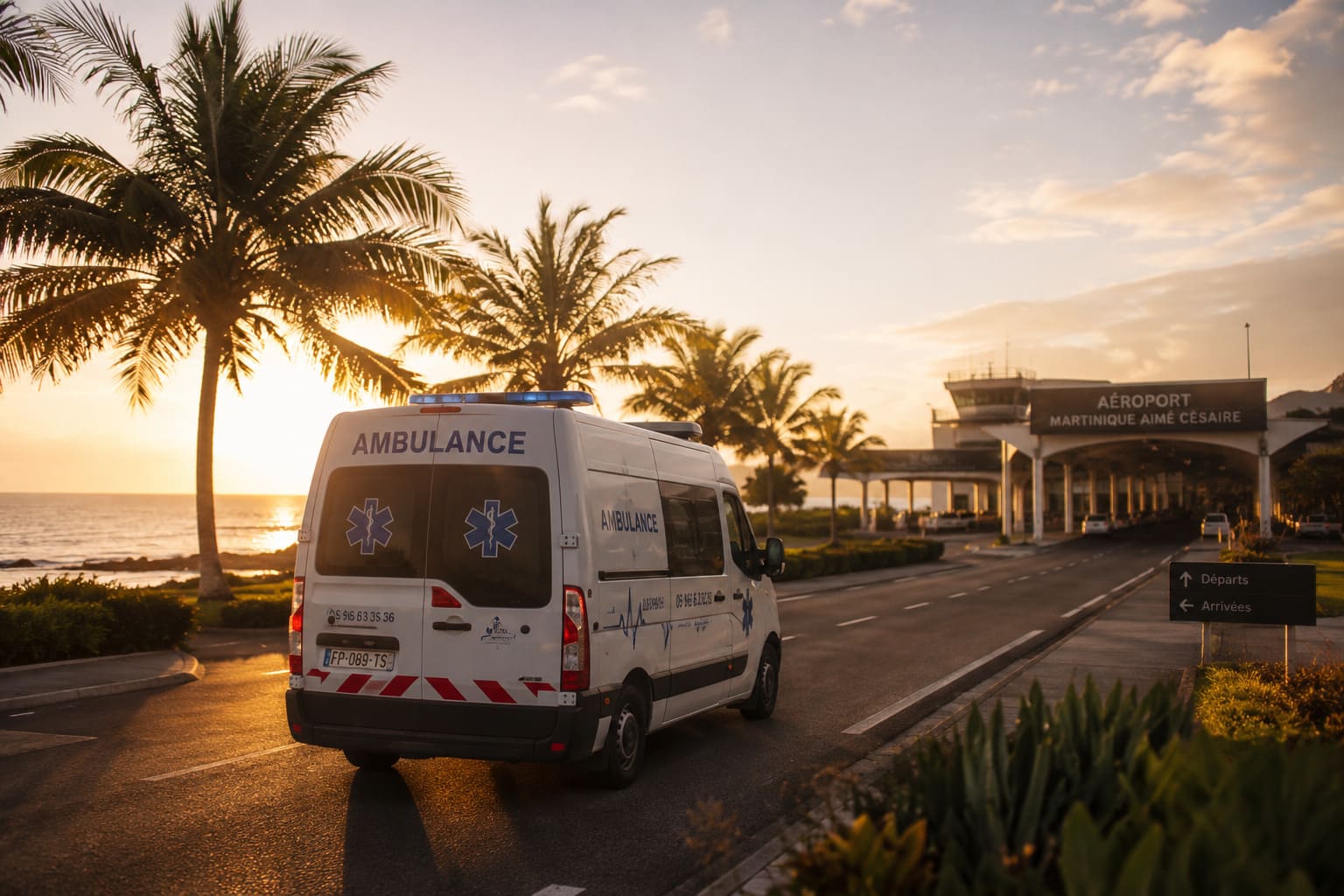
A ground ambulance transfers the patient from the hospital bed to the departure airport. This is never left to the family. WIA arranges the ground ambulance directly, coordinating the departure time with the hospital, the escort and the airport. At the destination, a second ground ambulance meets the flight. For patients returning to a receiving hospital or care facility, WIA coordinates the arrival with the receiving facility. For patients going directly home, the ambulance takes them there.
Step 4: In-Flight Medical Escort and Patient Care
The medical escort is the person physically present with the patient for the full journey. On a commercial medical repatriation flight, that is a nurse or doctor assigned to the case. On an air ambulance flight, it is a full medical crew including a flight doctor, flight nurses and, where required, a critical care specialist. The escort is briefed on the patient’s clinical file before departure and responsible for all medical care from the moment the patient leaves the hospital.
During the medical repatriation flight, the escort monitors vital signs, administers medication on schedule, manages oxygen and ventilator requirements where applicable, and handles any change in the patient’s condition. For patients on intensive care support, the escort team manages continuous monitoring throughout the air travel. WIA’s coordination centre in Fort-de-France stays in contact with the escort throughout the journey.
Medical Escort Services: Nurse or Doctor, and When Each Is Used
The level of medical escort is set during the assessment. Most post-surgical recovery patients and patients with stable medical conditions travel with a nurse. Patients with more complex clinical profiles travel with a doctor. In both cases, the escort carries medical equipment appropriate to the patient’s needs: oxygen supply, monitoring devices, medication and emergency first-response equipment.
WIA’s escorts are qualified medical professionals, not airline staff or general travel assistants. They are selected and briefed for each specific case. Their role does not end when the aircraft doors open at destination: they remain with the patient until the handover at the receiving facility or home.
→ Medical Escort: qualifications, equipment and service scope in full
Step 5: Bed-to-Bed Coordination and Patient Repatriation Services
The term “bed-to-bed” describes what WIA actually delivers: the patient moves from their hospital bed at origin to their bed at the destination, whether that is a receiving hospital, a care facility or their own home. No gap in care. No stage left unmanaged. The patient and their family never have to coordinate between separate providers.
WIA manages the full handover chain. The ground ambulance at origin is timed with the hospital’s discharge process. The escort accompanies the patient through boarding. At the destination airport, the ground ambulance is waiting. The escort provides the receiving doctors or family with a full clinical summary: diagnosis, treatment received at the foreign hospital, medication administered during the flight, and the patient’s condition on arrival.
Repatriation to Home vs. Repatriation to a Receiving Hospital
Patients WIA repatriates from the Caribbean are split roughly evenly between two destinations: home, and a receiving hospital. Another patient may need to continue treatment at a hospital closer to home. WIA coordinates the transfer to whichever destination applies, and where the patient needs to continue medical care on arrival, WIA liaises with the receiving hospital to confirm the admission before the flight departs.
Who Uses WIA Medical Repatriation Services?
Insurance Companies: The Primary Channel for Medical Repatriation
In most repatriations, it is the patient’s insurance company that contacts WIA to open the case. Travel insurance and international health insurance policies typically include medical repatriation cover. WIA works directly with more than 150 insurance companies, including most French assistance services, like Europ Assistance, AXA Assistance, Allianz Global Assistance, Inter Mutuelles Assistance, Mutuaide, Fidelia and FILA. The insurer receives real-time updates throughout the mission and full documentation on completion.
Families and Patients: Direct Medical Repatriation Work
When a patient’s travel insurance does not cover the return journey, or when families need to act without waiting for insurance procedures, WIA accepts direct mandates. Families who contact WIA directly are often dealing with a stressful and unfamiliar situation. WIA’s coordinators explain the process clearly, provide a transparent quote and handle every element of the repatriation. The family’s job is to be at the other end when the patient arrives.

Hospitals: Medical Emergency, Planned Transport and Travel Referrals
Caribbean hospitals, including the CHU de Martinique and CHU de Guadeloupe, refer patients to WIA when a supervised transfer is needed. In some cases this is planned: a patient is ready for discharge and the hospital initiates the repatriation. In others it starts as a medical emergency and WIA coordinates an urgent air ambulance service or air ambulance flight for a patient who needs to reach a more specialised facility quickly.
Medical Repatriation vs. Medical Evacuation: Understanding the Difference
Medical repatriation is the supervised return of a patient to their home country or chosen destination after medical treatment abroad. The patient has already received care at a hospital and is being transferred home. Medical repatriation services cover the full journey, not just the flight.
A medical evacuation (EVASAN) is different. It moves a patient from a location where adequate medical care is not available to the nearest appropriate medical facility. This is an emergency response to an acute medical emergency or injury. WIA coordinates both services from the Caribbean. The process overlap in their early stages, but medical evacuation is typically faster and more urgent, and the destination is a hospital rather than home.
Wing-to-wing transfers sit between the two: a patient arrives by commercial flight and needs a second dedicated air ambulance leg to reach a smaller destination airport. WIA coordinates these as part of its air ambulance service network.
→ Back to medical repatriation overview
→ Transport solutions: air ambulance, stretcher and commercial flight options
Frequently Asked Questions: Medical Repatriation Process and Services
How does the medical repatriation process work from start to finish?
It starts with a call to WIA, usually from the patient’s insurance company. A medical coordinator is assigned immediately and reviews the patient’s clinical file with the attending physician at the hospital. The right transport is identified based on the destination and the patient’s medical needs. WIA then handles the flight booking, medical clearance, escort assignment and ground ambulances at both ends. The patient travels with a nurse or doctor throughout. On arrival, WIA coordinates the handover to the receiving facility or family.
Who contacts WIA to start a medical repatriation?
In most cases, the patient’s insurance company contacts WIA directly. Insurance coverage for the return journey is the most common basis for a case. When a patient is not covered, or when families need to act without an intermediary, WIA accepts direct mandates. Hospitals, including the CHU de Martinique and CHU de Guadeloupe, also refer patients to WIA directly when a medically supervised transfer is needed.
What is the difference between medical repatriation and medical evacuation?
A medical evacuation (EVASAN) moves a patient from a remote or inadequate location to the nearest appropriate medical facility in an emergency. Medical repatriation moves a patient back to their home country or chosen destination after treatment, typically from a foreign hospital. WIA coordinates both. The most common scenario is a patient treated at the CHU de Martinique or CHU de Guadeloupe, ready to return home to France, the UK, Canada or elsewhere.
How quickly can WIA organise a medical repatriation?
A commercial medical repatriation flight is typically organised within 24 to 48 hours of the initial medical assessment, subject to flight availability. Air ambulance missions can be mobilised faster for urgent cases. WIA’s team responds to new cases within minutes, 24 hours a day, every day of the year.
Does travel insurance cover medical repatriation from the Caribbean?
Most travel insurance policies include medical repatriation cover. The scope varies: some policies cover only emergency transport, others cover the full return home after treatment. WIA works directly with insurance companies to manage pre-authorisation and cost documentation. For patients whose travel insurance does not cover the return, WIA provides transparent pricing for a direct mandate.
What happens on arrival? Does WIA organise the receiving end too?
WIA’s coordination team is available 24 hours a day, every day of the year. Whether you are an insurance company opening a case, a hospital referring a patient, or a family trying to bring someone home, the process starts with one call.
Ready to Start a Medical Repatriation from the Caribbean?
WIA’s coordination team is available 24 hours a day, every day of the year. Whether you are an insurance company opening a case, a hospital referring a patient, or a family trying to bring someone home, the process starts with one call.
→ Speak to a coordinator now — 24/7
→ Request a quote for any medical repatriation service
→ Medical repatriation transport solutions: all options explained
