
Most repatriations WIA organises start at the same point: a patient treated at the CHU de Martinique in Fort-de-France or the CHU de Guadeloupe in Pointe-à-Pitre, ready to go home. To France, the United Kingdom, Europe, Bresil, the United States, Canada. The transport decision is not primarily about clinical severity. It is about the destination.
If home is near a major international airport served by Air France or commercial airlines, WIA evaluates a commercial solution first. If not, a dedicated aircraft is necessary. For the full medical repatriation process, see the How It Works guide.
Medical Repatriation Transport Options: Four Solutions
A patient returning to Frankfurt from the CHU de Martinique travels by stretcher on Air France. A patient going home near a small regional airport needs a dedicated aircraft. The table below reflects that logic, not clinical severity.
| Transport Mode | When to Use It | Medical Level | Relative Cost | Lead Time |
|---|---|---|---|---|
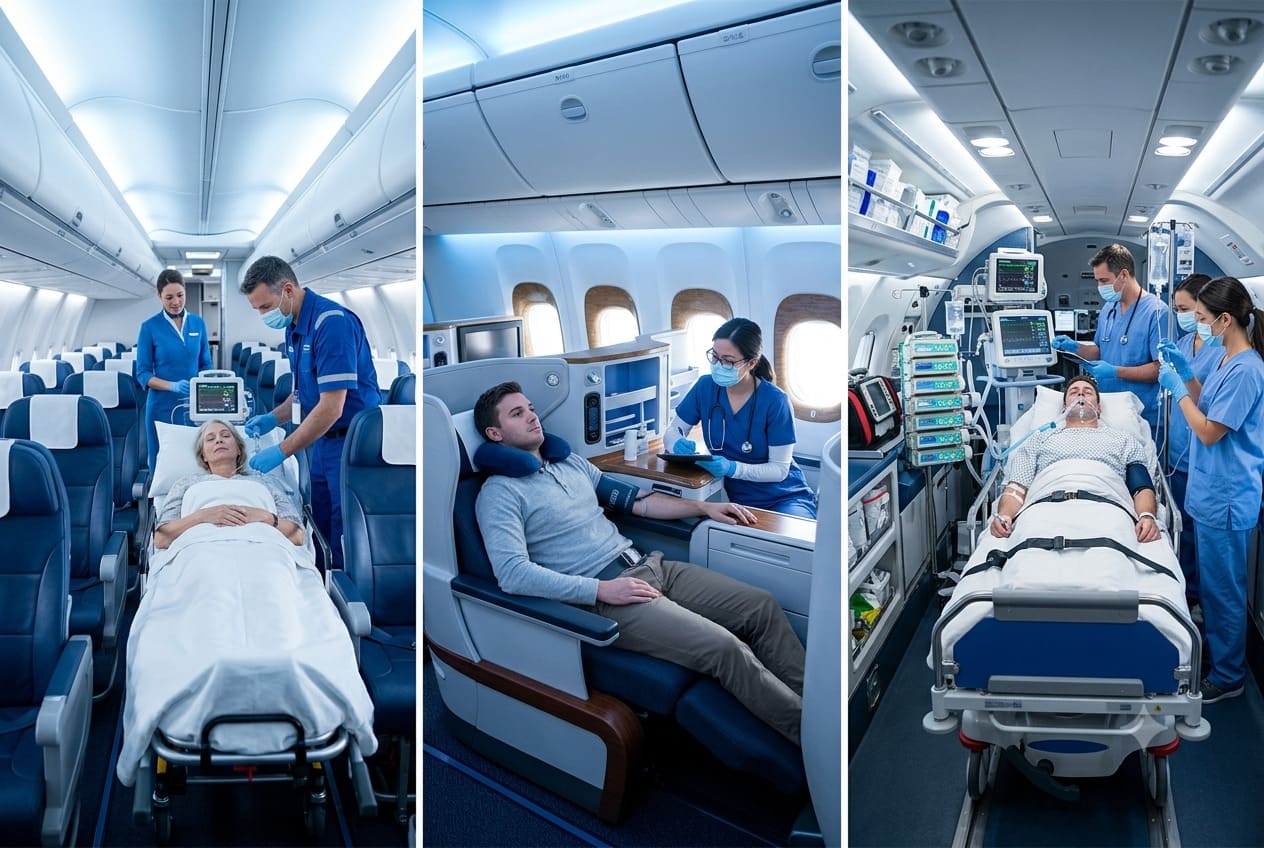
| Commercial Stretcher Flight | Destination served by a major international airport (Air France or equivalent). Patient must remain supine: hip fracture, post-surgical, intubated and ventilated. | Nurse or/and doctor on board | Optimised | 24–48h |
| Commercial Medical Flight | Destination served by a major international airport. Patient is fit to fly and can remain seated throughout. | Nurse or/and doctor on board | Lower | 24–48h |
| Air Ambulance | Destination only reachable via a small regional airport not served by commercial carriers, or wing-to-wing connection required. | Intensive care unit | Highest | Hours |
Each transport mode links to a dedicated page with full clinical indications, medical equipment details and FAQ.
Air Ambulance Medical Flight Transport: When the Destination Requires a Dedicated Aircraft
An international air ambulance is a dedicated medical aircraft with a doctor, flight nurse and medical team on board. It can land at any airport: regional, private, international. That is its core advantage over commercial airlines, and the primary reason WIA calls on one.
Air Ambulance Service: Route-Based, Not Severity-Based
When the final destination is not served by Air France or an equivalent carrier, a commercial stretcher is not an option regardless of patient condition. The air ambulance service reaches airports that scheduled services do not. WIA also relies on air ambulance partners for wing-to-wing cases: when a patient needs an onward connection to a smaller airport after a commercial inbound flight. These operators are essential partners, called on when the route requires it. Critical care capability on board is determined by the patient’s clinical needs, not by the transport mode itself.
→ Air Ambulance: routes, medical equipment and coordination process
Commercial Medical Flight Transport with Medical Escort Service
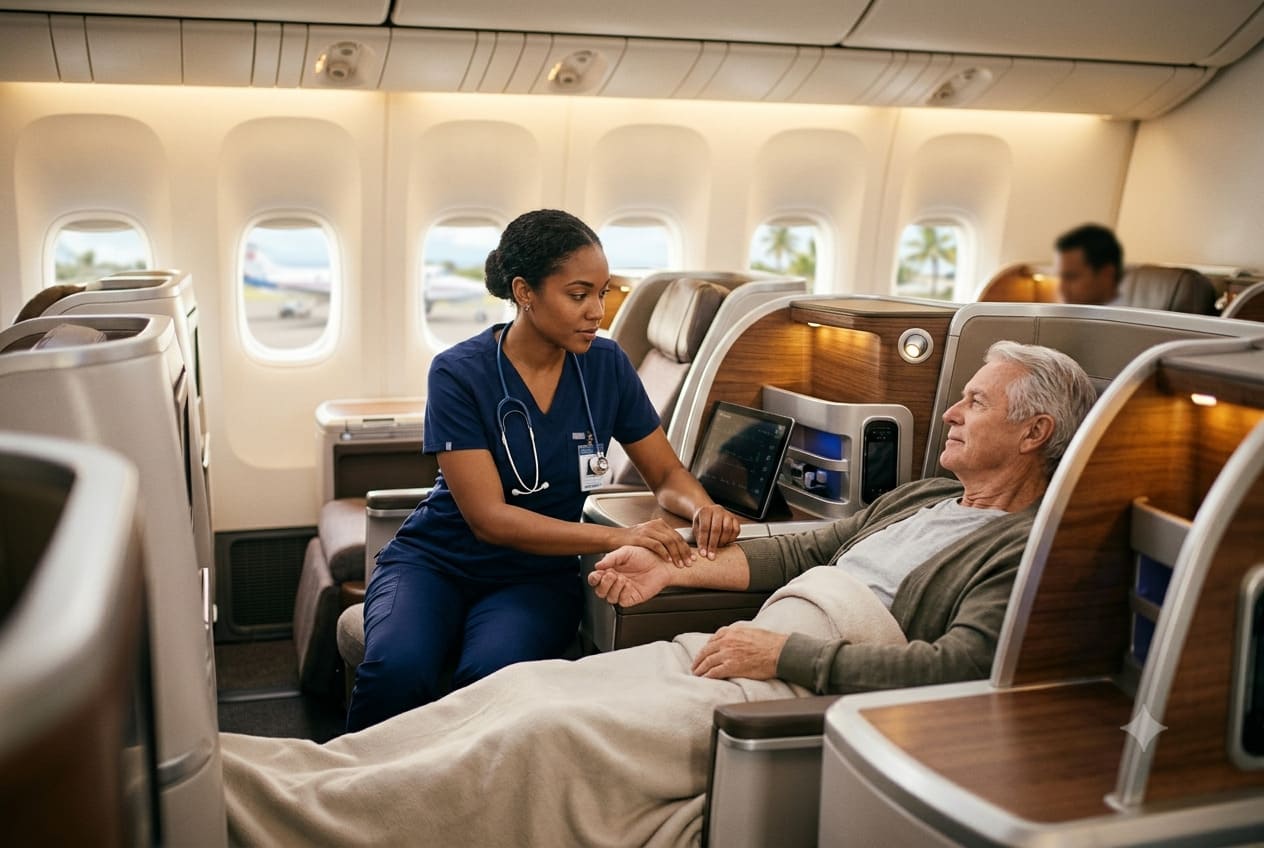
When commercial airlines serve the destination and the patient can remain seated, a business class medical repatriation flight is medically sound and more affordable than a dedicated aircraft. WIA’s medical escort service provides a nurse or/and doctor on board for the full journey.
Medical Repatriation Flight Services for Seated Patients: Eligibility
This is the most common scenario for patients discharged from the CHU de Martinique or CHU de Guadeloupe returning home to France, the United Kingdom or Canada. Air France (and several other airlines like American Airlines, Air Canada, Air Transat…) departs from Aimé Césaire International Airport in Martinique and Pôle Caraïbes in Guadeloupe. A doctor accompanies more complex cases; a nurse covers post-operative recovery. The escort level is set individually following the medical assessment.
→ Commercial Medical Flights: escort qualifications and booking process
Commercial Stretcher Flight Repatriation: WIA’s Core Expertise
The commercial stretcher is WIA’s primary differentiator. A patient returning from the CHU de Martinique with a hip fracture, a post-surgical condition, or a severe case where they are intubated and/or ventilated, can travel home on a scheduled Air France service, lying flat, with a nurse or/and doctor providing medical support on board, as long as the destination airport is served by commercial airlines.
Medical Evacuation vs. Commercial Stretcher Flight Repatriation
A medical evacuation (EVASAN) responds to a medical emergency by moving a patient to the nearest adequate medical facility. A commercial stretcher flight repatriates a patient home on a scheduled service, lying flat, with full medical supervision throughout. Air France operates air stretcher configurations from Martinique to Paris Charles de Gaulle. On the same Caribbean-to-Europe route, a stretcher flight costs 60 to 70% less than a full air ambulance, without compromising medical necessity or safety.
→ Commercial Stretcher Flights: air stretcher configuration, eligibility and routes
→ Request a quote for any transport option
→ Transport decision framework WIA applies to every case
How WIA Selects the Right Medical Repatriation Transport
The Medical Repatriation Process: Destination First, Clinical Factors Second
WIA’s medical team asks one question first: does Air France or an equivalent carrier serve the destination? Commercial options are evaluated before dedicated air transportation. Clinical factors then determine what level of care and medical equipment the flight requires. Insurance policies are reviewed once the appropriate options are identified.
| Question | What WIA Assesses | Impact on Transport Decision |
|---|---|---|
| Is the destination served by a major international airport? | Air France and equivalent carrier routes from Martinique or Guadeloupe to the final destination | Yes → commercial stretcher or medical flight evaluated first. No → air ambulance |
| Does the patient need to remain supine for the full flight? | Clinical file review, physician report, mobility assessment | Yes → commercial stretcher (if destination accessible) or air ambulance. No → seated commercial flight evaluated |
| Is schedule flexibility critical? | Urgency of departure vs. next available commercial service, risk of transit wait | Long wait or complex connection → air ambulance to avoid stranding patient in transit |
| What level of in-flight monitoring is required? | Oxygen dependency, ventilation, medication management, haemodynamic stability | ICU-level monitoring required → air ambulance. Supervised escort sufficient → commercial option |
| What does the insurance coverage allow? | Coverage type, pre-authorisation requirements, cost parameters | WIA presents the most appropriate option within what the insurance company has authorised |
Once the solution is confirmed, WIA presents the recommendation with full cost transparency for the insurance company or family. Ground ambulances handle both ends: ground ambulance transportation from the patient’s bed to the departure airport, and ground transportation from the arrival airport to the patient’s home or receiving facility.
→ Transport Decision Process: full criteria and methodology
→ Medical Assessment: what WIA reviews before any transport decision
Medical Transport Services: Who Relies on WIA
Insurance Companies and Medical Repatriation Partners
More than 150 international insurers rely on WIA, including the major French ones like Europ Assistance, AXA Assistance, Allianz Global Assistance, Inter Mutuelles Assistance, Mutuaide, Fidelia and FILA. WIA works directly with insurance companies on authorisation, cost documentation and real-time case updates.
→ B2B coordination team: contact and case submission
Hospitals, Medical Facilities and Clinicians
The CHU de Martinique in Fort-de-France, the reference hospital for the French Caribbean operating to European university hospital standards, and the CHU de Guadeloupe in Pointe-à-Pitre call on WIA when patients need medical supervision for their return home. WIA handles the transport assessment, carrier coordination and all logistics from the first call.
Patients, Families and Direct Transport Options
In most cases, the patient’s insurance company contacts WIA to organise the return. When a patient is not covered, or families need to act directly, WIA accepts mandates without an intermediary. The team is available 24 hours a day with transparent pricing before any commitment is made.
→ Speak to a WIA coordinator 24/7
→ Request a quote — all transport optins
→ Full repatriation process: Assessment → Decision → Bed-to-Bed Coordination
Frequently Asked Questions: Medical Repatriation Transport Options
How does WIA decide which transport mode is right for a patient?
The first question is destination: does Air France or commercial airlines serve the final airport? If yes, a commercial solution is evaluated first. If no, a dedicated aircraft is required. Insurance policies and clinical factors determine the level of medical support and equipment needed on board.
Is a commercial stretcher only for stable or mild cases?
No. A commercial stretcher on a scheduled Air France service can carry severe, intubated and/or ventilated patients. WIA has organised these medical repatriation flights for 15 years. The deciding factor is the destination airport, not the severity of the case.
What is the difference between a commercial medical flight and a commercial stretcher flight?
A commercial medical flight carries a seated patient in business class with a nurse or/and doctor providing medical support. A commercial stretcher flight carries a patient lying flat: seats are removed and replaced with a stretcher unit. Both work for destinations served by major international airports and cost significantly less than a dedicated aircraft.
When is an air ambulance required instead of a commercial stretcher?
When the destination is only reachable via a small regional airport not served by commercial airlines. Air France cannot land everywhere. An international air ambulance can. WIA also uses air ambulance partners for wing-to-wing transfers requiring a second dedicated leg. Clinical condition determines the level care and medical equipment on board, not the choice of transport mode.
Can WIA organise transport for a patient without travel insurance?
Yes. WIA accepts direct mandates from patients, families and hospitals with no insurance intermediary. Transparent pricing is provided based on the patient’s condition and destination before any booking is confirmed. Ground ambulances and ground transportation at both ends are included in the coordination.
Ready to Discuss Your Patient’s Case?
WIA’s coordination team is available 24 hours a day, 7 days a week. Whether you are an insurance company with a critical case in Martinique or a family organising a return home from Guadeloupe, the transport assessment is provided transparently before any commitment is made.
→ Request a quote — all transport options
→ Speak to a coordinator — 24/7 emergency line
→ Full repatriation process: Assessment → Decision → Bed-to-Bed Coordination
